An agent-based model of the US college application process using real acceptance data
An agent-based simulation of the US college admissions cycle
This simulation models the full US college admissions process as it actually works — from high school seniors building their college lists through every application round, to colleges filling their freshman classes. Every student and every college is an autonomous agent following real-world rules.
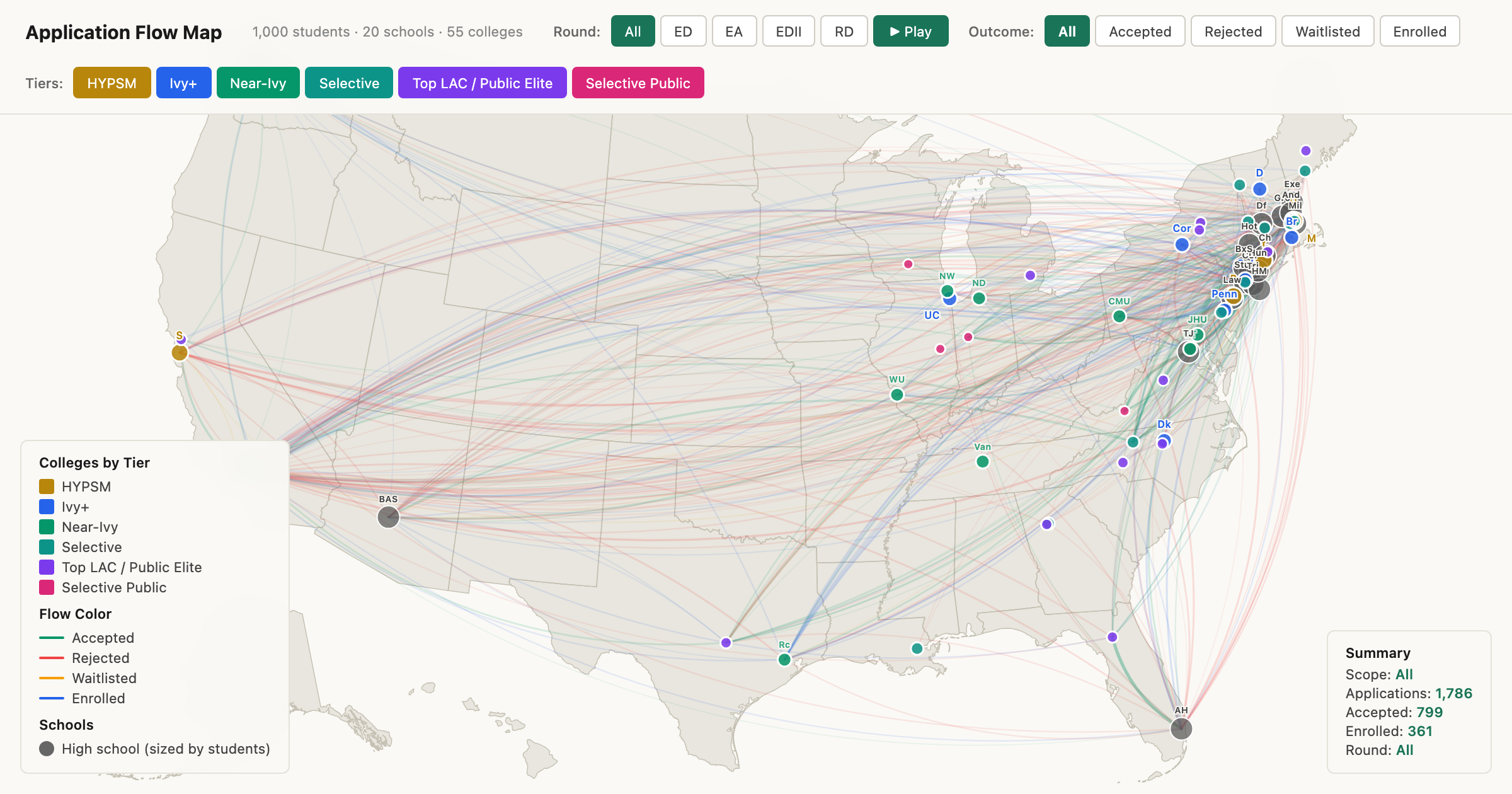
Left panel — High schools. Each card shows the student population with a GPA histogram, SAT distribution, and archetype breakdown. Students are generated from school-type distributions (elite boarding, public magnet, day school, etc.).
Center canvas — The arc visualization. Each arc is one application. Color encodes the target school's tier. Watch arcs light up green (accepted), red (rejected), or amber (deferred/waitlisted) as rounds progress.
Right panel — Colleges. Each card shows the school's real acceptance rate, the seat progress bar filling up as students commit, and a live breakdown of the admitted cohort by round.
Bottom dashboard — Statistics. Tabs show acceptance rates vs. real benchmarks, yield rates, hook analysis, and outcome distributions by high school.
How college admissions actually works in the US
US college admissions is a multi-round, holistic process that runs from October through May of a student's senior year. It is not a pure meritocracy — academic stats matter enormously but are not the only factor.
Students take the SAT/ACT, build extracurricular records, visit colleges, and begin narrowing their list.
Students finalize their college list: typically 8–14 schools split across dream/reach/target/safety tiers. Counselors recommend 2 reaches, 3–4 targets, 2–3 safeties.
Students submit their ED (binding) or EA/REA (non-binding) applications. Most top schools have Nov 1 or Nov 15 deadlines.
ED/EA decisions arrive. Students accepted ED must withdraw all other applications and commit. Others continue to RD.
Regular Decision applications due (Jan 1–Jan 15 at most schools). Students rejected ED may apply EDII at a different school.
Regular Decision letters arrive March–early April. Students with multiple acceptances must choose by May 1 (National Decision Day).
Top colleges use holistic review — no single number guarantees admission or rejection. Admissions officers (AOs) read applications and score them across multiple dimensions. Harvard, for example, uses a 1–6 scale across: Academics, Extracurriculars, Athletics, Personal Qualities, and School Support.
Typical weighting: Academic (35–40%) · Extracurriculars (20–25%) · Essays (15–20%) · Recommendations (10–15%) · Institutional Needs (10–15%).
The six rounds simulated and how they differ
| Round | Deadline | Decision | Binding? | Avg. ED Boost |
|---|---|---|---|---|
| ED — Early Decision | Nov 1–15 | Mid-Dec | Yes | 1.2×–4.5× acceptance rate |
| EA — Early Action | Nov 1–15 | Mid-Dec | No | ~1.2×–1.5× |
| REA — Restrictive EA | Nov 1 | Mid-Dec | No, but exclusive | ~1.5× (Harvard, Yale, Princeton, Stanford) |
| SCEA — Single Choice EA | Nov 1 | Mid-Dec | No, but exclusive | Same as REA |
| EDII — Early Decision II | Jan 1–15 | Feb | Yes | 1.3×–2× |
| RD — Regular Decision | Jan 1–Feb 1 | Late March–April | No | — |
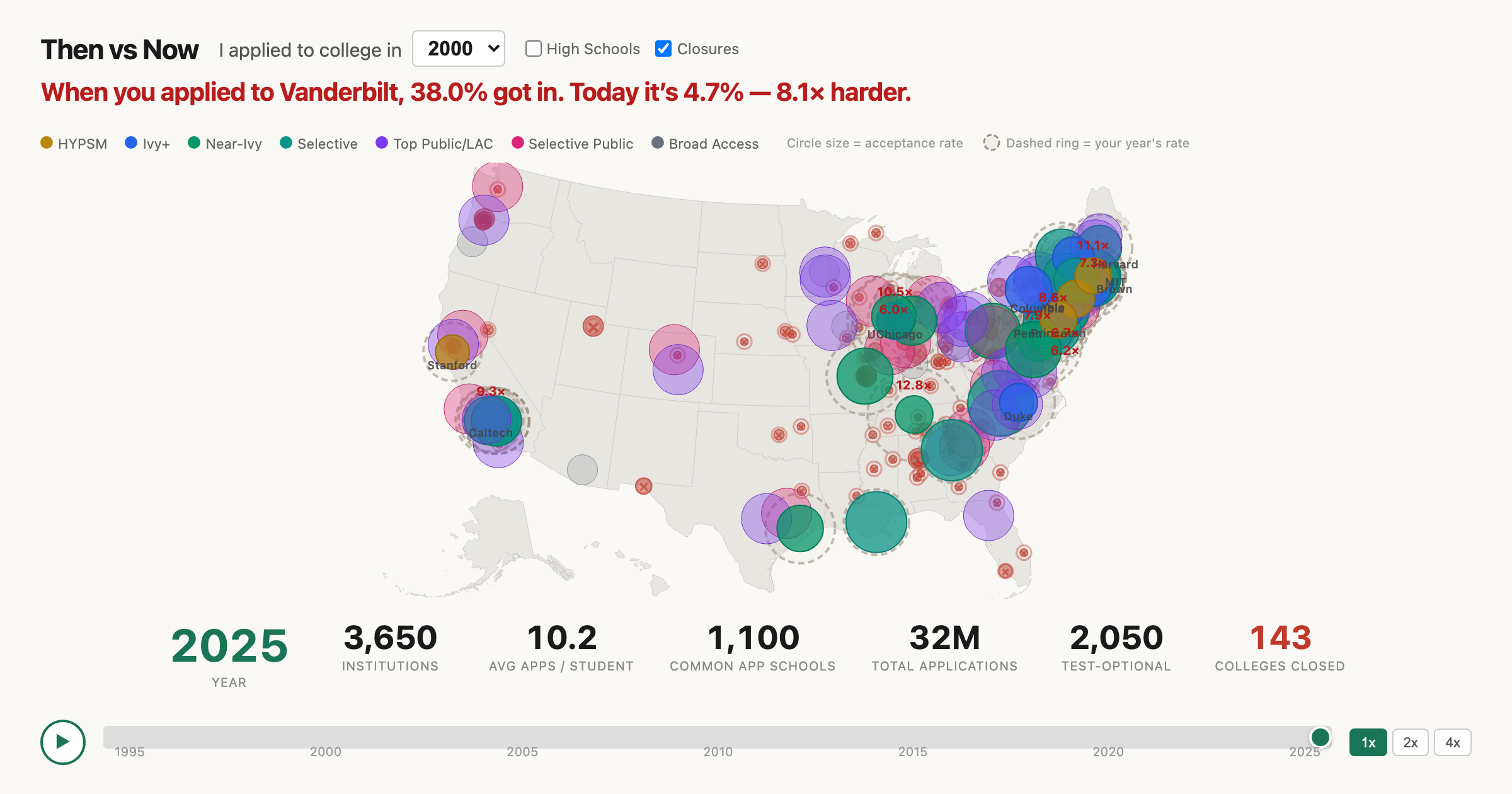
ED dramatically improves admission odds. Duke accepts ~21% of ED applicants vs. ~4.5% overall. Williams: ~37% ED vs ~11% overall. The boost exists because colleges prize yield certainty — an ED admit is guaranteed to enroll.
Harvard, Yale, Princeton, and Stanford offer Restrictive Early Action — non-binding (you don't have to enroll if accepted) but exclusive (you can't apply ED elsewhere or to other private schools' EA). This lets top students apply early without the financial aid risk.
Deferred: Your ED/EA application is moved to the RD pool for reconsideration. You may update your application. About 5–15% of deferred applicants are ultimately admitted.
Waitlisted: After RD, some rejected applicants are placed on a waitlist. Colleges offer waitlist spots to fill any gaps after May 1. Waitlist admission rates range from 0% to ~15% and are highly unpredictable.
How colleges are classified in this simulation — and in admissions lingo
| Tier | Schools | Acceptance Rate | Typical SAT |
|---|---|---|---|
| HYPSM | Harvard, Yale, Princeton, Stanford, MIT | 3.6%–5% | 1480–1580 |
| Ivy+ | Columbia, UPenn, Brown, Dartmouth, Cornell, Duke, Northwestern, UChicago, Caltech | 3.9%–11% | 1440–1570 |
| Near-Ivy | Johns Hopkins, Vanderbilt, Rice, Notre Dame, Georgetown, Carnegie Mellon, WashU | 7%–18% | 1410–1560 |
| Selective | Emory, Tufts, Boston College, UVA, UCLA, Michigan | 11%–26% | 1300–1520 |
| Top LACs | Williams, Amherst, Middlebury | 9%–15% | 1390–1540 |
Students categorize schools on their own list differently — based on their personal chance of admission:
How students are generated and what their attributes mean
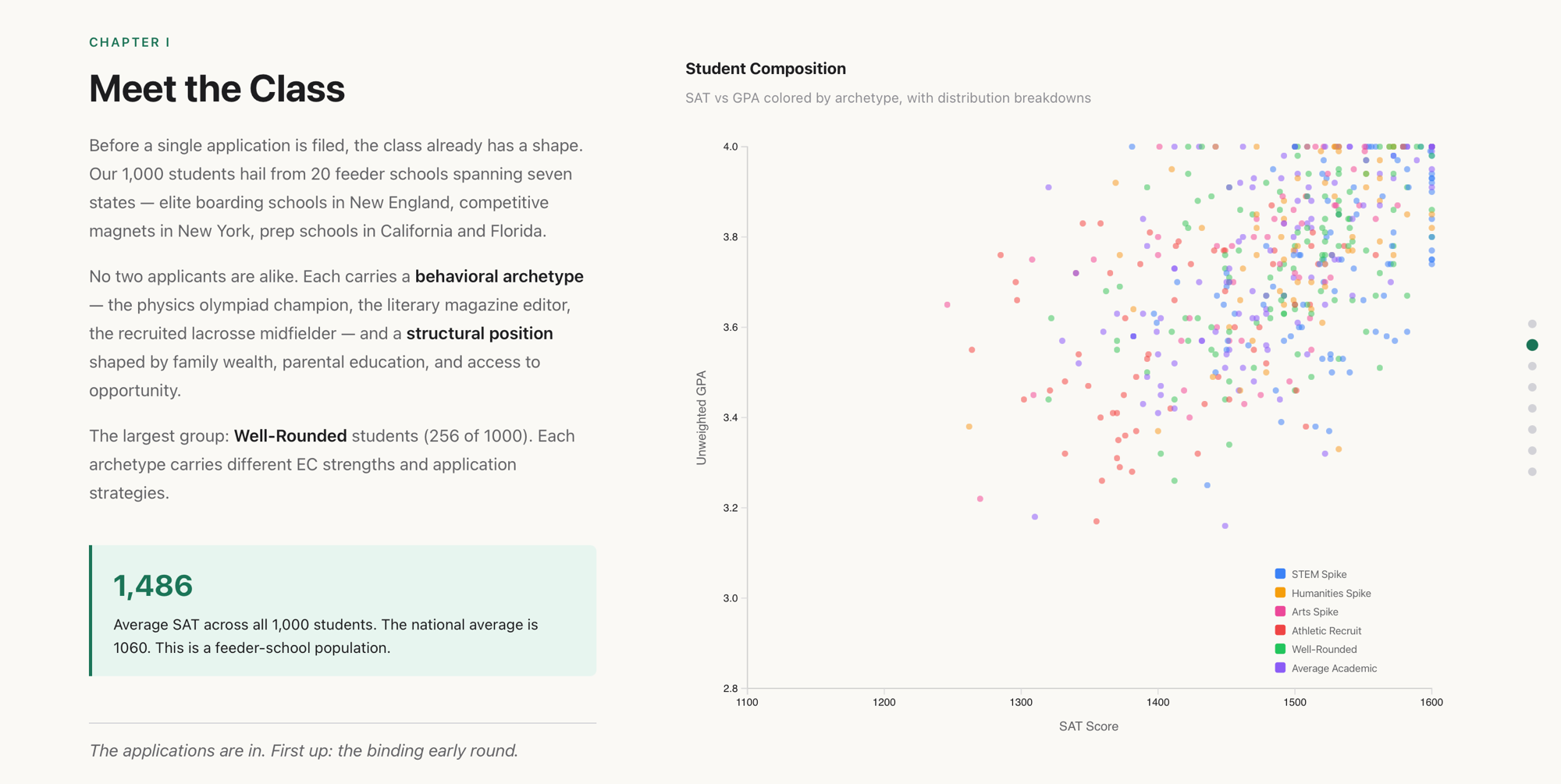
Each student is drawn from distributions calibrated to their high school type. Attributes:
| Attribute | Range | Notes |
|---|---|---|
| Weighted GPA | 2.8–4.5 | Accounts for AP/IB course difficulty. Differs from unweighted (max 4.0). |
| SAT Score | 900–1600 | Combined Math + Reading/Writing. Used alongside GPA as "academic index." |
| EC Quality | 1–10 | Extracurricular strength. 8–10 = national competition winner, research publication, elite athlete. 4–6 = solid school-level involvement. Scores ≥ 9.0 receive a nonlinear spike bonus in admissions scoring. |
| Essay Quality | 1–10 | Modeled essay strength. Elite admissions coaches note essays rarely overcome weak academics but can tip borderline cases. |
| Gender | male / female | Assigned probabilistically: elite boarding, NYC private, and public magnet schools skew 55% male. Gender affects admissions at STEM-heavy schools (MIT, Caltech, CMU favor female applicants ~1.9×) and LACs (Williams, Amherst, Middlebury favor male applicants ~1.25×). |
| Archetype | Profile | Apps Filed | Ivy Admit Rate |
|---|---|---|---|
| STEM Spike | High GPA/SAT, national math/science competition, research | 10–16 | ~8–15% |
| Humanities Spike | Strong GPA, exceptional writing/debate/model UN, standout essays | 8–13 | ~6–12% |
| Athletic Recruit | Actively recruited by coach — admissions advantage independent of academics | 4–8 | ~25–50% |
| Well-Rounded Leader | Strong across all categories, student government, multiple varsity sports | 8–13 | ~5–10% |
| Arts/Creative | Portfolio-based spike in music, art, theater; audition/portfolio process | 6–10 | ~4–8% |
| Legacy/Development | Parent attended, donor connection; institutional preference applied | 5–9 | ~30–45% |
| First-Gen/URM | First in family to attend college, underrepresented background | 5–9 | ~10–18% |
| Strong Applicant | Solid stats but no exceptional spike; the "well-rounded" average | 8–13 | ~2–5% |
Application counts reflect research-backed patterns: STEM students apply broadly across many schools; athletes apply to fewer because recruitment narrows the target set; disadvantaged students apply to fewer due to lower process familiarity and counselor access (CommonApp data, Class of 2029).
Each student is assigned an income bracket (1=low income → 5=high income) based on their high school type and structural position. Elite boarding school students skew high-income (bracket 4–5); public magnet students skew middle (bracket 2–3); disadvantaged-position students skew low-income (bracket 1–2). Income affects college choice: low-income students weight a school's financial aid generosity more heavily when deciding between acceptances — modeled after Avery & Hoxby (NBER): each $1,000 in grant aid raises yield probability by ~11 percentage points.
Unweighted GPA (max 4.0) treats all courses equally. Weighted GPA (often 5.0 scale) gives extra points for AP (typically +1.0) and IB (+0.5–1.0) courses. Colleges recalculate GPAs using their own rubrics to compare across schools — a 4.5W at Stuyvesant means something different than a 4.5W at a school with inflated grades.
How this simulation decides who gets in
Each application generates a composite score compared against a threshold that varies by school. The algorithm has 8 steps:
GPA and SAT are normalized against the school's typical admitted range, averaged, and passed through a sigmoid curve. This prevents "score stacking" — a 1600 SAT at a school where the median is 1550 doesn't help as much as it would at a school where the median is 1400.
Extracurricular quality (1–10) and essay quality (1–10) are normalized and blended in. EC is weighted ~0.25×, essay ~0.15× of the academic score contribution. A nonlinear spike bonus is added: EC ≥ 9.0 (national competition winner, USAMO, Intel STS) adds +8 points; EC ≥ 7.5 (regional/state leadership) adds +3 points. Based on Harvard SFFA trial data: EC rating 1 applicants were admitted at 50.6% vs. 3.8% for EC rating 3.
The composite academic+EC+essay score is multiplied by the school's feeder strength (1.05×–2.50×). Elite boarding schools (Exeter, Andover, Collegiate: 2.2–2.5×) produce students whose applications are systematically stronger through better preparation, counseling, and institutional relationships. A student from Collegiate School with an average score gets 2.5× the raw score of an equivalent student from a charter school — consistent with Opportunity Insights research showing a 2–2.5× compound feeder advantage.
The big non-academic factors. Applied as multipliers to the post-feeder score. Includes donor, athlete, legacy, first-gen, Pell eligibility, URM, geographic diversity, gender (at STEM-heavy and LAC schools), and income residual. See Hooks & Boosts section for full detail. Hook effectiveness diminishes slightly for academically very strong students — a donor with a 1600 SAT doesn't need as much of a boost as a donor with a 1400 SAT.
ED/REA applicants receive a boost derived from the ratio of early to overall acceptance rate, calibrated to Class of 2029 actuals. The cap was raised to 4.5× to accommodate schools like UChicago (4.0×) and Vanderbilt (4.0×). Examples: UChicago ED 4.0×, Vanderbilt ED 4.0×, Dartmouth ED 3.5×, Northwestern ED 3.8×, Columbia ED 3.4×, Harvard REA 2.5×, Stanford REA 2.0×, MIT EA 1.2×, Notre Dame REA 1.2×. Georgetown EA clamps to the minimum 1.2× since their EA rate is no better than RD. EDII applicants receive ~65% of the ED boost (capped at 3.0×).
A random factor in [0.75, 1.25] is applied — modeling the genuine unpredictability of human review, essay resonance, reader subjectivity, and timing in the pool.
The final score is compared against the school's computed threshold. Threshold is calibrated to hit the real-world acceptance rate on average.
Colleges track seats remaining per round (ED fills ~25–40% of class; EA fills ~10–15%; RD fills the rest). Once a class is full, no more acceptances — even high scorers are rejected.
The non-academic factors that move the needle — backed by research
A "hook" is admissions jargon for any factor that gives a student an advantage beyond pure academic merit. Research from Harvard's own internal documents (revealed during the SFFA v. Harvard lawsuit) and other sources quantifies these effects.
| Hook | Boost by Tier | Real-world Evidence |
|---|---|---|
| Donor / Development | 7.5× (HYPSM) → 2.5× (LAC) | Harvard SFFA trial: "Dean's List" applicants admitted at ~42% vs. 5.6% unhooked ≈ 7.5× odds ratio. Arcidiacono expert testimony. |
| Recruited Athlete | 4.5× (HYPSM) → 2.0× (LAC) | Harvard SFFA trial: recruited athletes admitted at ~86% vs. 5.6% baseline. MIT uses weaker model — no formal coach slots or likely letters (+200 SAT-pt equivalent at Ivies). |
| Legacy (Parent Alumnus) | 5.7× (HYPSM) → 2.0× (LAC) | Harvard SFFA trial: legacy admitted at ~33% vs. 5.6% unhooked ≈ 5.9× odds ratio. MIT, Johns Hopkins, and Amherst have eliminated legacy preference. |
| First-Generation | 1.4× | Documented positive adjustment in holistic review at most selective schools as part of socioeconomic diversity goals. Stacks with Pell eligibility (below). |
| Pell Grant Eligible | 1.25× | Post-SFFA, schools use socioeconomic factors as race-neutral proxies for diversity. Pell eligibility (first-gen or income bracket ≤2) is a concrete signal. First-gen + Pell stacks to 1.4 × 1.25 = 1.75×. |
| Gender (STEM schools) | Female: 1.9× at MIT/Caltech/CMU | Caltech and MIT actively recruit women in STEM. Female applicants receive a significant boost at stem_heavy schools. Calibrated to Caltech's confirmed ~2× female advantage. |
| Gender (LACs) | Male: 1.25× at Williams/Amherst/Middlebury | Liberal arts colleges have seen sustained male underrepresentation (~40% male) and actively recruit male students. Williams/Amherst/Middlebury apply a modest male advantage. |
| Income Residual | Q5 (top): 1.15× · Q1 (bottom): 0.92× | Chetty, Deming & Friedman (2023): top-1% income students are 2× more likely to attend Ivy-Plus at equal test scores. Most of this gap is explained by athlete/legacy/donor hooks (already modeled). A small residual 1.15× applies to unhooked high-income students — representing counselor quality, network access, and application polish not captured by feeder tier alone. |
| Geographic Diversity | 1.3× | Students from underrepresented states (ND, WY, MT, ID) have an advantage at schools seeking national geographic spread. Overrepresented: NJ, CT, MA. |
Hooks work as "tips" — they tilt borderline decisions. A donor-flagged applicant with a 1200 SAT won't get into Harvard. But a donor-flagged applicant with a 1500 SAT who is otherwise a borderline candidate has a dramatically higher chance. The academic floor still exists.
Some schools track whether applicants have visited campus, attended information sessions, or emailed admissions offices. Demonstrating genuine interest can be a small positive signal at schools like Tufts, Notre Dame, Boston College, and Vanderbilt. Ivies officially don't consider it — but many believe it still registers subtly.
What the numbers in the dashboard actually mean
This simulation uses a fixed pool of ~15–30 elite high schools. Real applicant pools include hundreds of thousands of students from every school type. Your simulated acceptance rates will be lower than real-world rates because every simulated student is above-average — they all come from highly competitive schools.
When a student receives multiple offers, they choose based on four weighted factors: prestige tier (40%), archetype fit (27%), legacy connection (13%), personal preference noise (10%), and financial aid attractiveness (10%). The aid factor is income-sensitive — low-income students (bracket 1–2) receive a strong boost toward schools with generous need-based aid (Harvard, Princeton, MIT, Williams all meet 100% of demonstrated need with no loans), while high-income students (bracket 4–5) are effectively aid-indifferent. MIT leads real-world yield at 87% — its EA round is non-binding but students who get in almost always attend. Harvard is close at 84% (top prestige + best aid). Large public universities like UCLA (18%) and Michigan (20%) admit many competitive students who ultimately choose a private school instead.
Each college card shows two data rows beneath the yield line. The first row (ISLR/USNWR data) shows: % students from top-10 HS, graduation rate, student/faculty ratio, alumni giving rate, and per-student expenditure. The second row (College Scorecard 2022–23) shows enrolled class demographics: W=White, A=Asian, B=Black, H=Hispanic, 1G=First-generation college student.
Every term you'll encounter in college admissions
| Term | Definition |
|---|---|
| AO | Admissions Officer — the person at a college who reads and evaluates your application. |
| Academic Index (AI) | Ivy League standardized formula combining class rank and test scores to compare applicants across schools. Exact formula is not published. |
| Common App | The Common Application — the shared application platform used by 900+ colleges. Most students fill it out once and submit to multiple schools. |
| Coalition App | Alternative to Common App used by ~150 colleges. |
| Demonstrated Interest | Actions showing you genuinely want to attend a school: campus visit, email to AO, attending virtual info session. Tracked by many schools. |
| Development Case | Applicant whose family has made or is expected to make significant donations. Flagged by the development office and tracked separately. |
| Dream School | A school where your admission chances are very low (<15%) but you apply because you'd love to attend. Often used interchangeably with "reach." |
| EA — Early Action | Non-binding early round. Apply Nov 1–15, hear back Dec 15. You can apply EA to multiple schools (unlike ED) and aren't obligated to enroll. |
| ED — Early Decision | Binding early round. If admitted, you must enroll and withdraw all other applications. Significantly boosts admission odds at most schools. |
| EDII — Early Decision II | A second binding round with a January deadline. Offered by ~100 schools. Useful for students rejected ED at their first choice. |
| Feeder School | A high school with a historic track record of sending students to specific elite colleges. Relationships are informal but real. |
| First-Generation | Student whose parents did not complete a four-year college degree. Many schools actively recruit first-gen students. |
| Gap Year | Taking a year off between high school and college. Students who defer enrollment often "take a gap year." |
| Holistic Review | Evaluating applicants as whole people rather than by test scores alone. The official policy at most selective schools. |
| Hook | Any non-academic factor that significantly boosts admission odds: athletic recruitment, legacy status, donor connection, first-generation status, etc. |
| Ivy League | The eight schools: Harvard, Yale, Princeton, Columbia, UPenn, Brown, Dartmouth, Cornell. An athletic conference that became shorthand for elite universities. |
| LAC | Liberal Arts College. Small (1,000–3,000 students), focused on undergraduate education. Williams, Amherst, Middlebury are top examples. |
| Legacy | A student whose parent(s) attended the same college. Legacies receive significant preference at most private schools. |
| Likely Letter | Unofficial early signal sent to highly desirable applicants (especially athletes) before formal decisions. Indicates very likely admission. |
| Match / Target School | A school where your stats align with the average admitted student — you have a realistic 50–75% chance of admission. |
| May 1 | National Decision Day. The deadline by which students must commit to a college and pay their enrollment deposit. |
| QuestBridge | A program connecting high-achieving low-income students to full scholarships at ~50 partner colleges. |
| RD — Regular Decision | The standard application round. Apply Jan 1–Feb 1, hear back March–April. No binding commitment. |
| REA — Restrictive EA | Used by Harvard, Yale, Princeton, Stanford. Non-binding like EA but restricts you from applying ED elsewhere or EA at other private schools. |
| Reach School | A school where your stats are at or below the average admitted student. Admission is possible but not expected. |
| Recruited Athlete | A student actively sought by a college athletic coach. Coaches provide "likely letters" and work with admissions to secure spots. The single biggest hook. |
| Safety School | A school where your stats significantly exceed the average admitted student and you have a 75%+ chance of admission. Everyone should have at least 2. |
| SCEA — Single Choice EA | Yale's term for their restrictive early action policy. Functionally identical to REA. |
| SFFA v. Harvard | Students for Fair Admissions v. Harvard (2023). Supreme Court ruling ending race-conscious admissions at US colleges. |
| Spike | One area of extraordinary achievement — national competition winner, published researcher, professional athlete. Preferred by elite AOs over "well-rounded" applicants. |
| Superscoring | Taking the highest section scores from multiple SAT sittings to form the best composite. Most schools superscore; some don't. |
| Test-Optional | Policy allowing students to apply without submitting SAT/ACT scores. Adopted widely during COVID, retained by many schools. Does not mean test-blind. |
| Test-Blind | School does not consider SAT/ACT even if submitted. MIT and Caltech reverted to test-required. True test-blind schools are rare (Hampshire, Pitzer). |
| Waitlist | After RD, some students are placed on a waitlist. Colleges offer admission from the waitlist if enrolled students below yield targets. |
| Weighted GPA | GPA that adds extra points for AP/IB courses. Common scales: 5.0 (AP), 4.5 (honors). Different from unweighted 4.0 scale. |
| Yield | The percentage of admitted students who actually enroll. High yield (Harvard 84%) means nearly everyone who gets in attends. Colleges optimize for yield. |